

Krishna Prema's Food for Thought 2026 # 3 — Following in the Footsteps of the Walking Monk
The kīrtana is in full swing. All around me, people dance with joy, their faces lit with huge smiles and their eyes fixed on the Swami on stage. Some seem deeply moved, others simply fascinated. I watch in amazement. Maharaja clearly knows what he is doing.
The way he leads the kīrtana, the way he moves, the way he connects with the crowd—it is like watching an experienced conductor leading an orchestra. Within minutes, he has everyone chanting and dancing. The kīrtana intensifies, the mṛdaṅga beats faster, and the whole crowd chants Hare Kṛṣṇa with great happiness. I play karatālas, sing along, and simply observe the spectacle. For a moment, I feel as if I have been transported back to the 1970s and the early days of the Hare Kṛṣṇa movement.
We had left Toronto at five that morning and driven seven hours to reach this open-air kīrtana festival near Montreal in time for our noon slot. After prasāda and a group picture, we were back on the road. The Sunday Feast at ISKCON Montreal was our next stop.
Welcome to life on the road with the Walking Monk.
31 Days in Canada
I came to Canada at the request of the Sannyasa Ministry to travel for two weeks with HH Bhaktimarga Swami and then spend another two weeks preaching in the Greater Toronto Area. The visit was part of my training as a sannyāsa candidate. What an experience it turned out to be.
Thirty-one days. Seventeen cities. More than thirty talks and programs. Festivals, Sunday Feasts, a temple opening, a university interfaith dialogue, yoga studios, harināma, home programs, a youth seminar, brahmacārī classes, mantra meditation programs and much more. But numbers tell very little about what made these thirty-one days so special.
Beyond the adventure of travelling and discovering new places, there was the extraordinary variety of preaching, the uplifting association of Maharaja, the sweet exchanges with devotees, and, above all, the happiness of Kṛṣṇa-kathā and sharing Kṛṣṇa consciousness with others.
On the Road with the Walking Monk
Four weeks earlier, I hardly knew Bhaktimarga Swami personally. Of course I knew who he was, but we had had little direct exchange. Suddenly, I found myself spending hours and hours travelling with him and seeing his preaching and leadership up close in all kinds of situations. It did not take long for Maharaja to capture my heart.
The travelling could be intense—many hours on the road, one program after another, and sometimes very little time in between. But those same hours also gave me something precious: quality sādhu-saṅga and the opportunity to observe an experienced sannyāsī not only when he was sitting on a vyāsāsana giving a class, but in the car, at the temple, with devotees, while taking prasāda, walking, swimming, planning programs and dealing with the countless practical details of preaching life.
One Sunday captures something of the experience. We began with a morning house program for community members in Mississauga, including breakfast and lunch. From there we travelled to Muskoka for a kīrtana program at the beautiful Om Yoga studio, followed by a Balarāma Jayantī festival in Niagara. And, of course, after all three programs, Maharaja still took me to see Niagara Falls that evening!
There were many days like this.
A Spiritual Home in Toronto
The second half of my stay was somewhat more settled. I stayed at the Toronto temple, a vast former church acquired in 1972—an acquisition Śrīla Prabhupāda celebrated as a great triumph.
What impressed me particularly was the Bhakti Academy, a program inspired by Krishna House in Gainesville. Establishing the Academy required adjustments to traditional temple life, but seeing the result made its value obvious. Around eighteen young devotees bring tremendous life and energy into the temple.
The Academy includes devotees in different situations. Some serve full-time, while others study at university or have jobs and participate according to their possibilities. Yet they come together for the morning program and support a remarkable variety of outreach activities throughout the week: university programs, yoga studios, mantra meditation evenings, weekend outreach and the Sunday Feast.
Living with them gave me a sweet experience of āśrama life and reminded me how much vitality young devotees can bring to a temple when they are given association, responsibility and meaningful service.
Moments I Will Remember
There were far too many special experiences to recount them all.
One was an interfaith dialogue at the University of Toronto, where I joined a Christian priest in discussing the question, “Who am I?” from Christian and Hindu perspectives. There were also Balarāma Jayantī, Rādhāṣṭamī and Janmāṣṭamī celebrations in different communities, intimate home programs, large temple gatherings and many opportunities for kīrtana and Kṛṣṇa-kathā.
One particularly memorable Janmāṣṭamī celebration took place at the home of Indresh Gaura Prabhu, the local GBC. Four sannyāsīs had gathered as special guests, along with two brahmacārīs, one of whom was myself. Together, we participated in a sādhu panel and interview. It was a beautiful experience of Vaiṣṇava association.
But perhaps one of the most meaningful moments came during Janmāṣṭamī at the Toronto temple. Around 15,000 visitors passed through the temple over the course of the evening. Besides leading a kīrtana, I had been asked to perform the midnight ārati for Śrī Śrī Rādhā-Kṣīracora Gopīnātha—a service I felt deeply honoured to receive. For many years, this ārati had been the service of Subhavilasa Prabhu, Indresh Gaura Prabhu's father and a disciple of Śrīla Prabhupāda. When I first heard that he wanted to offer me his service that year, I was taken aback and initially hesitant to accept. Indresh encouraged me. His father, he explained, was inspired to see a younger European preacher taking up greater responsibility within the GBC and aspiring for sannyāsa, and he wanted to give me this opportunity.
Worshipping Their Lordships at midnight was a deeply devotional and moving experience. When I came before the Deities again the following morning, I felt that something had changed. There was a sweetness and a sense of connection that had not been there before. It reminded me of something very simple about bhakti: relationship develops through service. We serve Kṛṣṇa, and through that service our relationship with Him becomes increasingly personal.
A Family of Devotees
The same principle applies, perhaps even more tangibly, in our relationships with devotees. Wherever I went, devotees received me with remarkable kindness. I received so much affection, encouragement and appreciation, and had countless sweet exchanges. I had come to Canada hoping to serve and give something, but again and again I found myself on the receiving end.
At the centre of much of this was Bhaktimarga Swami.
Maharaja reminded me of a loving grandfather who somehow remains connected with the whole family. He is there for the morning program, sits in class, joins the morning exercises and takes prasāda with the devotees. He is personal, approachable and humorous.
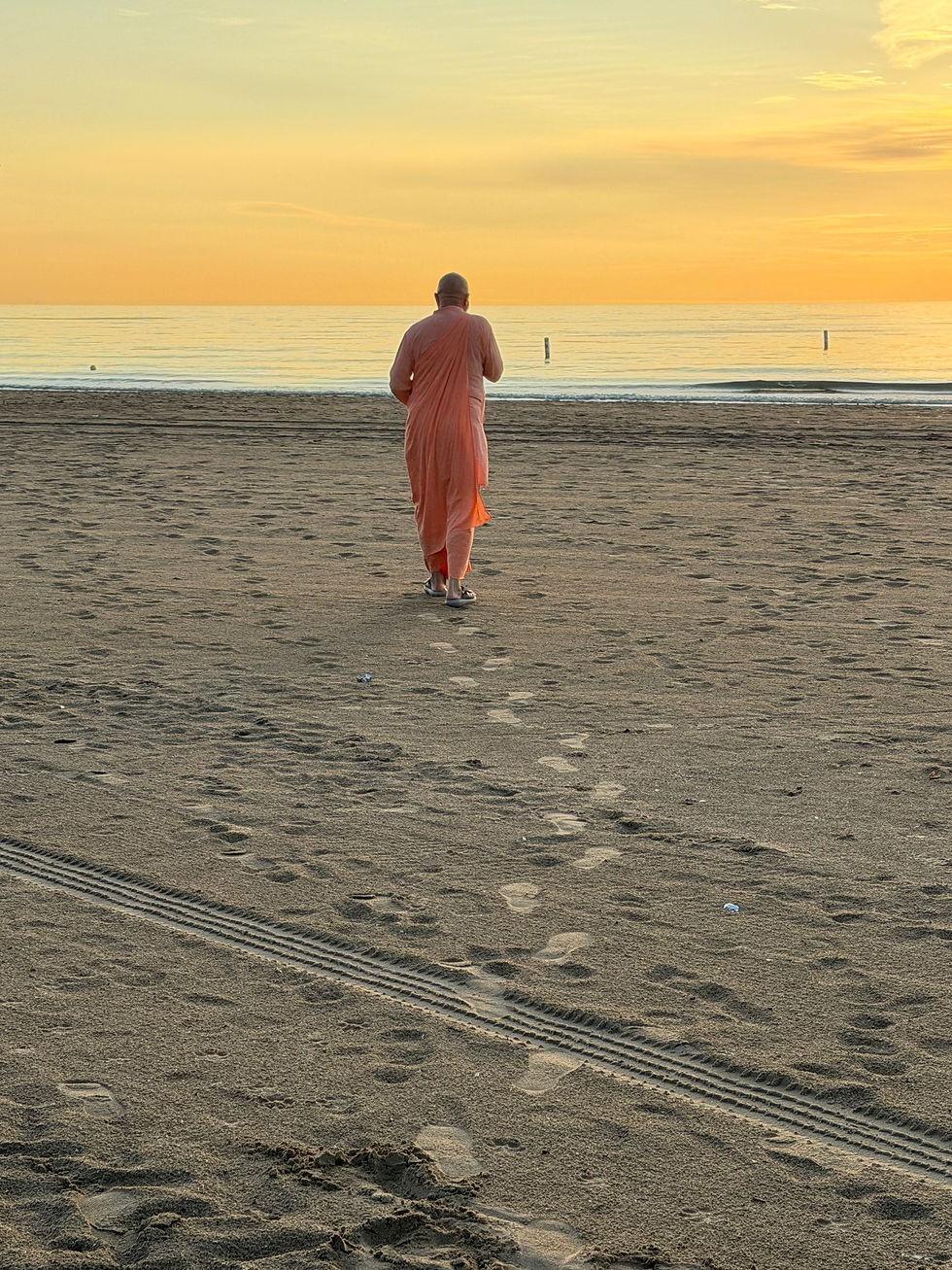
And he has a wonderfully creative and joyful approach to life. On the road, we might suddenly stop at a lake for a swim. At the temple, he might decide that today's morning program should take place at the beach.
And then, of course, there are the walks.
Maharaja takes almost every opportunity to walk. Sometimes this means asking the driver to stop before reaching the destination so that he can walk the remaining distance—even late in the evening. There is a reason he is known as the “Walking Monk.” He has crossed Canada on foot four times, as well as undertaking long walks in many other parts of the world.
Learning from a Sannyāsī
The whole purpose of travelling with a senior sannyāsī was not simply to accompany him from one program to another. It was to observe a role model in action and learn from someone who has lived this life for many years.
I feel very fortunate that I was given this opportunity with Bhaktimarga Swami.
For me, Maharaja embodies several ideals to which I also aspire. He has been connected with ISKCON Toronto for more than fifty years and has become a pillar of the community. He teaches through personal example. He is simple, accessible and humble, yet at the same time highly individual and creative.
He writes poetry, dramas and books. He creates music. He maintains a daily blog documenting his travels and encounters. His style of kīrtana is very powerful and unmistakably his own. He has found ways of presenting Kṛṣṇa consciousness that reflect his personality without losing sight of the tradition he represents.
That taught me something important: becoming a sannyāsī does not mean becoming a copy of another sannyāsī. We follow the same principles and serve the same mission, but each person has to discover how best to use his own nature and gifts in Kṛṣṇa's service.
Sannyāsa Means Service
Beyond the inspiration I received from Maharaja personally, Canada also gave me valuable insights into what it actually means to be a sannyāsī—or, more broadly, a spiritual leader whose responsibility is to uplift and inspire others.
Yes, one receives respect. During my stay, devotees offered obeisances, showed great affection, gave donations and sometimes even addressed me as “Maharaja,” although I am not a sannyāsī yet. Such experiences made me think more deeply about the relationship between honour and responsibility.
When people offer respect to someone in a spiritual role, that respect should not simply be enjoyed. It creates an obligation. Their respect needs to be reciprocated with service, spiritual care, encouragement and Kṛṣṇa-kathā.
Sannyāsa cannot be about me being at the centre. It has to be about asking: How can I assist? How can I serve? How can I help the devotees move forward in their spiritual lives?
It also means learning to adjust. As a travelling preacher, you cannot always determine the schedule, the audience, the circumstances or even what will be asked of you. You arrive somewhere and try to understand: What is needed here? How can I serve?
That may itself be part of the training.
What Makes Them Keep Going?
On the last day, when I finally left the Toronto temple after my stay in Canada, the devotees gathered, sang kīrtana and said goodbye. It was difficult to leave. One receives so much through these loving exchanges with devotees.
The life of a travelling preacher can look very blissful—and indeed it is. But it is also intense. Watching Maharaja made me wonder: What makes someone continue travelling like this year after year, especially as one grows older?
For Bhaktimarga Swami, the answer became increasingly clear to me: compassion.
Maharaja said to me more than once that hardly a day passes when he is not concerned about the situation in the world. People are suffering. People need Kṛṣṇa consciousness. And therefore, he feels, we need to preach, establish centres and expand.
I saw something similar in the extraordinary development taking place in Canada under the leadership of Maharaja, Indresh Gaura Prabhu and so many dedicated devotees.
Behind all the travelling, organizing, fundraising, building, speaking, singing and expanding, there can be something much deeper than ambition. There can simply be the desire to serve.
Perhaps this was the most important lesson Canada gave me about sannyāsa. Renunciation is not primarily about withdrawing from the world. It is about becoming increasingly available to serve Kṛṣṇa, the devotees and those who are searching for spiritual life.
Thirty-one days later, I returned with many memories, much gratitude—and certainly much still to learn. But I also returned with a clearer picture of the path ahead.
For a few precious weeks, I had been allowed to follow in the footsteps of the Walking Monk.


Kommentare